Half-Court, Full Heart: The Neighborhood Hoop That Never Sends You a Bill
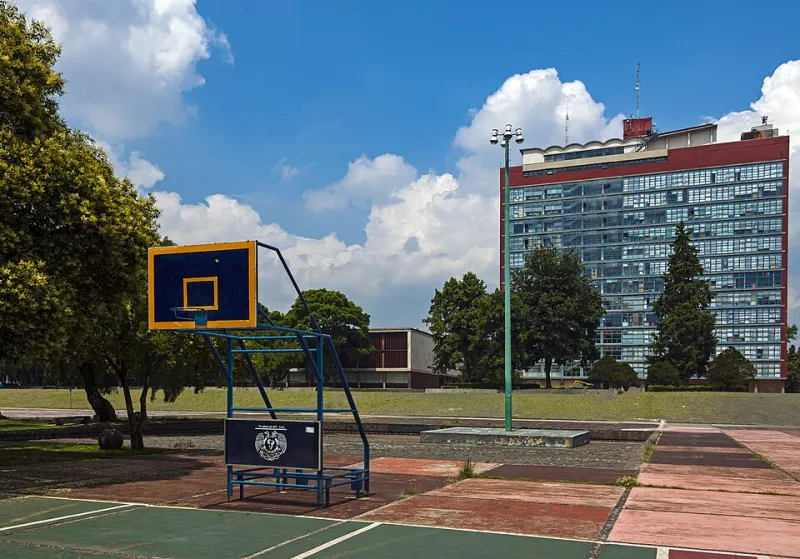
Photo: Daniel Case, CC BY-SA 3.0, via Wikimedia Commons
There's a specific sound that lives at the edge of every Filipino neighborhood. Not a playlist, not a notification — a basketball hitting asphalt with the rhythm of a metronome nobody set. Someone's cousin is calling next game. A lola is fanning herself on a plastic monobloc chair. An uncle in a tank top has been 'watching' for four hours and hasn't left. Nobody paid to be there. Nobody's the customer.
In the US, we keep trying to buy our way back into that feeling — and it's not working.
The $18 Hangout
American third places have been quietly rebranded as transactions. Want to shoot hoops? That's a day pass at LA Fitness or a court reservation app with a waitlist. Want to hang out somewhere that isn't your apartment? Cool, that's a $7 latte and an unspoken two-hour limit. Rec leagues, climbing gyms, indoor mini-golf bars — all fun, all fine, all behind a paywall or a booking screen.
Sociologist Ray Oldenburg coined 'third place' decades ago to describe the spaces between home and work where community actually happens. What he probably didn't predict is that American cities would keep the phrase and lose the point: a third place you have to pay for isn't a third place. It's a venue.
What the Kanto Court Knows
In the Philippines, the half-court at the kanto — the corner — is civic infrastructure the way a fire hydrant is. It's often just a slab of concrete, a bent rim, maybe floodlights donated by the barangay. And yet it runs on a schedule that no one owns and everyone follows: after school, after work, after the heat breaks around 5 PM.
The magic isn't the basketball. It's the roles. There are the kids too small for the rim who retrieve balls and absorb slang. There's the uncle who hasn't played since 1997 but provides officiating, commentary, and unsolicited life advice. There are the titas on the sidelines turning the sideline into a talk show. Games end not when someone wins but when it gets too dark to see the ball, and everyone drifts home without a single goodbye being formal.
Presence is the only admission ticket. You show up, you're in. You don't show up, the court doesn't guilt-trip you with an email.
Why American Courts Went Quiet
A lot of US neighborhoods technically have courts. The problem is everything around them. Public courts in car-dependent suburbs sit empty because nobody walks past them — you have to decide in advance to go, drive, and hope someone else had the same idea. Meanwhile, the courts that are alive tend to be alive because of what surrounds them: a corner store, a bus stop, houses with windows facing the pavement.
That's the actual Filipino blueprint. The kanto court isn't a destination — it's a byproduct of density. It sits where life already flows, so 'going to the court' and 'hanging out' are the same sentence. In most American suburbs, those are two different plans requiring two different car trips.
Add in the litigiousness, the 'no loitering' signs, the parks that close at dusk, and you get infrastructure that technically exists and functionally doesn't.
What Planners Could Steal
No one's saying every cul-de-sac needs a barangay-style hoop. But the kanto court offers a few transferable lessons:
- Put the court where people already are. Next to the boba shop, the laundromat, the transit stop. Foot traffic does the marketing.
- Make loitering legal again. Benches, shade, no reservation required. A court without seating is a gym; a court with seating is a living room.
- Let the community run it. The best Filipino courts are maintained by the people who play on them, not an app. Light touch from the city, heavy ownership from the block.
- Light it at night. Games don't end at sunset in Manila. Floodlights extend the hangout by hours and make the space feel watched over, not policed.
Some US cities are already catching on — pickup-friendly courts with permanent lights in Dallas, community-built slabs in Detroit, courts doubling as event spaces in Queens. The pattern that works is always the same: low barrier, high visibility, zero gatekeeping.
The Real Score
Here's the part that's hard to put in a zoning document: the kanto court works because it expects nothing from you. No membership, no streak to maintain, no leaderboard. You can go alone and leave with people. You can go and not play at all. The uncle on the chair is as much a participant as the 6'2" kid hitting fadeaways.
That's what commercial third places can't replicate — they need you to spend, so they need you to be a customer first and a neighbor second. The court flips it. Neighbor first. Everything else optional.
America doesn't lack concrete or rims. It lacks permission to just be somewhere. The kanto court never asked for permission, and that's exactly why it's never empty.