Three Wheels, Zero Chill Missing: How the Pinoy Tricycle Is Schooling American Cities on Getting Around
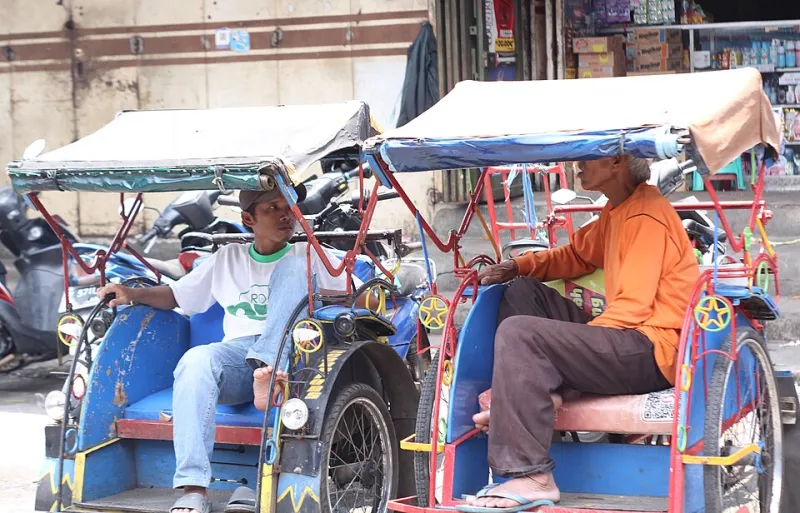
Photo: Randynovianr, CC BY-SA 4.0, via Wikimedia Commons
There's a moment every tambay knows. You're standing on a street corner somewhere in the Philippines, the sun's doing its worst, and a tricycle driver pulls up — sidecar rattling, radio playing, one mirror held on with what appears to be hope and zip ties. No app. No surge pricing. No scannable QR code on the handlebars. Just a guy, a vehicle, and a very clear understanding of every shortcut within a two-kilometer radius.
Now picture that energy in Brooklyn.
It's already happening, honestly. The tricycle — the Philippines' scrappiest contribution to global transit culture — is having a low-key moment in American cities. And unlike the scooter graveyard that's accumulated on every downtown sidewalk since 2018, this movement has personality. It has drivers who know your name. It has a philosophy that fits neatly into a site like this one: hang out, get around, don't overthink it.
The Trike Goes Stateside
Start with food delivery. In dense neighborhoods across New York, cargo trikes and e-assist three-wheelers have become the workhorses of the gig economy, threading between double-parked box trucks where cars can't go and e-bikes won't fit. A chunk of the drivers pushing this shift are Filipino or Filipino-American, and some of them are openly borrowing from the playbook back home — the tricycle's core logic that a small vehicle with a big attitude can cover the 'last half-mile' better than anything with four wheels.
Marco Dela Cruz, 34, drives delivery in Bushwick and grew up riding trikes in Bulacan. 'Back home, the tricycle driver is basically the neighborhood's GPS,' he told us over merienda (his words, his chicken adobo). 'He knows which alley floods, which guard lets you cut through, which loading dock is actually open at 9 PM. That knowledge is the product. The vehicle is just the delivery method.'
That hyper-local knowledge is exactly what American micro-mobility keeps failing to replicate. Venture-backed scooter apps dropped thousands of identical vehicles into cities they didn't understand, then acted surprised when riders abandoned them in rivers and the unit economics collapsed. The tricycle model flips that: the vehicle is cheap, the operator is local, and the service is accountable to the block it operates on.
Austin, Seattle, and the Pedicab Underground
If you've been to Austin during SXSW or a bad night on Rainey Street, you've seen the closest American cousin: the pedicab. Same DNA — a small passenger cab, a driver with hustle, cash-friendly, zero parking anxiety. Seattle's pedicab crews do similar work around the waterfront and stadium events, and the drivers skew heavily toward immigrants and students who treat the job less like gig work and more like running a tiny franchise.
The Filipino tricycle adds something the US version hasn't fully embraced yet: fixed, informal routes. In the Philippines, trikes don't wander — they own a corridor. The market run. The church route. The school gate at dismissal time. It's transit shaped by community rhythm rather than algorithmic demand spikes.
Urban planners have started paying attention. Mikaela Torres, a transportation consultant who's worked with cities in California and the Philippines, says the lesson isn't literally importing sidecars. 'It's the model,' she explains. 'Micro-franchised, hyper-local short trips, operated by people who live where they drive. American cities keep trying to solve the last-mile problem with hardware. The tricycle solves it with sociology.'
Several pilot programs — from cargo-trike delivery co-ops in Portland to slow-neighborhood shuttle experiments in Los Angeles — are circling the same idea without always naming it. But anyone who's flagged down a trike in Quezon City recognizes the blueprint immediately.
Short Ride, Big Personality
Here's the argument that should end the debate: the tricycle model beats another scooter app on every metric that actually matters to regular people.
A scooter is a transaction. A trike ride is a relationship. You know your driver. Your driver knows your building, your schedule, your dog. When something goes wrong, there's a human to flag down, not a chatbot in a help center that answers in 48 hours. The tip goes to a person, not a platform.
It's also, frankly, more fun. Trike culture back home is a whole aesthetic — custom paint jobs, sound systems that would embarrass a car audio shop, sidecars decorated like rolling fiestas. That DIY customization energy is exactly what Fil-Am car clubs already brought to the US, and it's trickling into the pedicab and cargo-trike scene. The vehicle is a billboard for the driver's identity. Try expressing yourself through a gray e-scooter.
And practically? Trikes handle cargo better, park in absurd spaces, and run on human power or small batteries instead of a logistics network that ships scooters across the country every three months.
What Tambay Culture Gets That Tech Doesn't
The deeper lesson is the one this site keeps coming back to: the best urban solutions come from people who've mastered the art of hanging out. Tambay culture — the Filipino tradition of lingering, chatting, existing in public space without a purchase required — is baked into tricycle operations. Trike stands are social infrastructure. Drivers wait together, share intel, watch the block.
American cities don't need a new app. They need more corners where a driver knows your name and a short ride comes with a conversation. The tricycle figured that out decades ago. We're just catching up.
Next time you see a trike or pedicab rolling through your neighborhood, flag it down. Tip well. Ask about the route. That's not just a ride — that's a masterclass.