Your $18 Desk Salad Is Losing to Last Night's Adobo
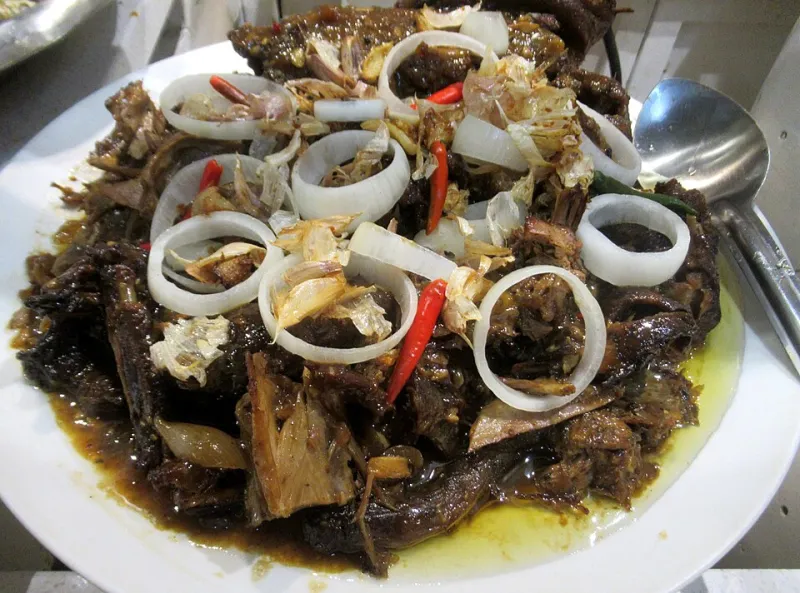
Photo: CNEcija12345, CC BY-SA 4.0, via Wikimedia Commons
Somewhere around 12:40 p.m. on a Tuesday, a plastic clamshell of kale and three cherry tomatoes changes hands for $18. The buyer feels virtuous for roughly nine minutes. By 2:15 they're hungry again and buying a $6 cold brew to cope.
At the other end of the break room, somebody is peeling back the lid on last night's adobo, and the whole floor turns to look.
That smell is not a marketing campaign. That's baon.
The midday meal got expensive, then it got sad
In 2026, the $18 desk salad has become a ritual of quiet surrender. You pay for convenience, you receive a container of cold vegetables, and you eat it at your keyboard while answering a Slack message you were not tagged in.
The math gets worse the more you look at it. Roughly $18 a day, five days a week, is about $360 a month — a car payment for the privilege of feeling mildly disappointed at 12:45 p.m.
Baon is the opposite reflex. It's the Filipino word for food you bring with you, and it carries zero martyrdom. Nobody in a Filipino household packs a lunch to punish themselves. They pack it because the food at home is better, and because there is always more of it than there was for dinner.
Baon is not meal prep, and this matters
Meal prep is a Sunday project that ends with five identical containers of grilled chicken and the low-grade depression of eating the same thing on Thursday that you ate on Monday.
Baon is leftovers with pride. You cooked a big pot of something on Sunday — chicken adobo, pork sinigang, giniling with potatoes — because cooking a small pot of Filipino food is basically impossible. Then you portion the surplus with rice and you eat well all week without pretending you're on a program.
The distinction is psychological. Meal prep treats food as compliance. Baon treats food as a thing you already own and are smart enough to bring along.
Build the plate
You don't need a recipe list to start. You need a formula that survives a microwave and tastes good cold if the microwave line is long.
- Rice. The foundation, and the reason you'll actually be full. Day-old rice reheats better than fresh. If you're rice-averse, swap in whatever grain you already keep.
- Ulam. One saucy meat or fish dish, cooked in quantity. Adobo, kaldereta, chicken tinola, even a simple ground pork with garlic and soy. Saucy is the move — it soaks into the rice and it never tastes dry on day three.
- Something bright. Quick-pickled cucumber, sliced tomato, a spoon of atsara. This is what stops the container from feeling like a punishment.
- Sawsawan. A tiny sidecar of soy, vinegar, and crushed garlic, or calamansi if you can get it. Condiments are how you make the same base taste like a different lunch by Friday.
- A piece of fruit or a boiled egg. Something to eat with your hands, off the clock, before the afternoon starts.
That's the whole architecture. Rice, something saucy, something bright, something to dip.
The ritual is the point
The reason baon beats the $18 salad has less to do with money than with posture.
When you pack lunch, you have decided in advance that your midday break is a real event. You are not squeezing food into the gap between meetings. You are sitting down, opening a lid, and eating something that came from your own kitchen. In a Filipino office, that's also a social event — containers get traded, someone's tita's dried fish becomes everyone's problem for an afternoon, and for fifteen minutes nobody is replying to anything.
That's tambay energy applied to a lunch break. Doing nothing, together, on purpose.
Logistics for the skeptical
A few practical notes, because the container is half the battle.
- Get containers that seal properly and stack without drama. Glass if you care about stains, plastic if your commute is hostile.
- Keep one container of rice in the freezer at all times. It reheats in three minutes and it kills the “there's nothing to eat” excuse.
- Reheat saucy dishes with a splash of water or a damp paper towel over the top. It brings them back to life instead of steaming them into leather.
- Buy one small insulated bag. It solves the “I'll just buy something” spiral better than willpower does.
- Cook double on any night you're already at the stove. That's the entire secret. You are not cooking an extra meal; you are making a bigger pot of the meal you were making anyway.
The office politics of reheated adobo
Fair warning: the moment you start bringing baon, people will want some. Adobo in a communal microwave is a scent event, and once the floor identifies you as the person with good containers, you will get asked “what's that” a lot.
You can share. Or you can cite the oldest rule in the Filipino household: what's packed is packed. Either answer is culturally accurate.
Pack the thing. Bring the thing. Eat it sitting down, with a window view if the office has one. Your lunch break was never going to be fixed by a better salad. It gets fixed by deciding that lunch is worth a container.